Moral Foundations Theory: An Approach to Cultural Variation
If the slides are not working, or you prefer them full screen, please try this link.
Essay Question
This section is relevant for answering the following question:
Notes
Aim of Moral Foundations Theory
Moral Foundations Theory (MFT) aims to provide:
‘a systematic theory of morality, explaining its origins, development, and cultural variations’ (Graham et al., 2011, p. 368).
What the Theory Claims
Moral Foundations Theory is the conjunction of four core claims.[1]
1. Nativism: The first claim is a form of nativism, often expressed metaphorically as ‘There is a first draft of the moral mind’. More formally:
‘the human mind is organized in advance of experience so that it is prepared to learn values, norms, and behaviors related to a diverse set of recurrent adaptive social problems’ (Graham et al., 2013, p. 63).
2. Cultural Learning: Second, moral psychology is affected by cultural learning:
‘The first draft of the moral mind gets edited during development within a culture.’
3. Intuitionism: Third, the Social Intuitionist Model of Moral Judgement is claimed to be true. This model involves several ideas (some considered briefly in Moral Disengagement: Significance), including:
‘moral evaluations generally occur rapidly and automatically, products of relatively effortless, associative, heuristic processing that psychologists now refer to as System 1 thinking’ (Graham et al., 2013, p. 66)
and:
‘moral reasoning is done primarily for socially strategic purposes’ (Graham et al., 2013, p. 66)
The Social Intuitionist Model proposes that moral judgments are typically caused by intuitions and independently of reasoning. (Note that proponents of the Social Intuitionist Model do not have our notion of intuition in mind here: after all, an intuition is a claim and a claim cannot cause anything.) Conscious reasoning usually occurs after the judgment is made, serving primarily to justify it to others (post-hoc reasoning). While reasoning might sometimes influence one's own judgment (private reflection), its main causal role is social: one person's reasoning influences another person's intuitions (reasoned persuasion).
The Social Intuitionist Model is depicted in this figure:
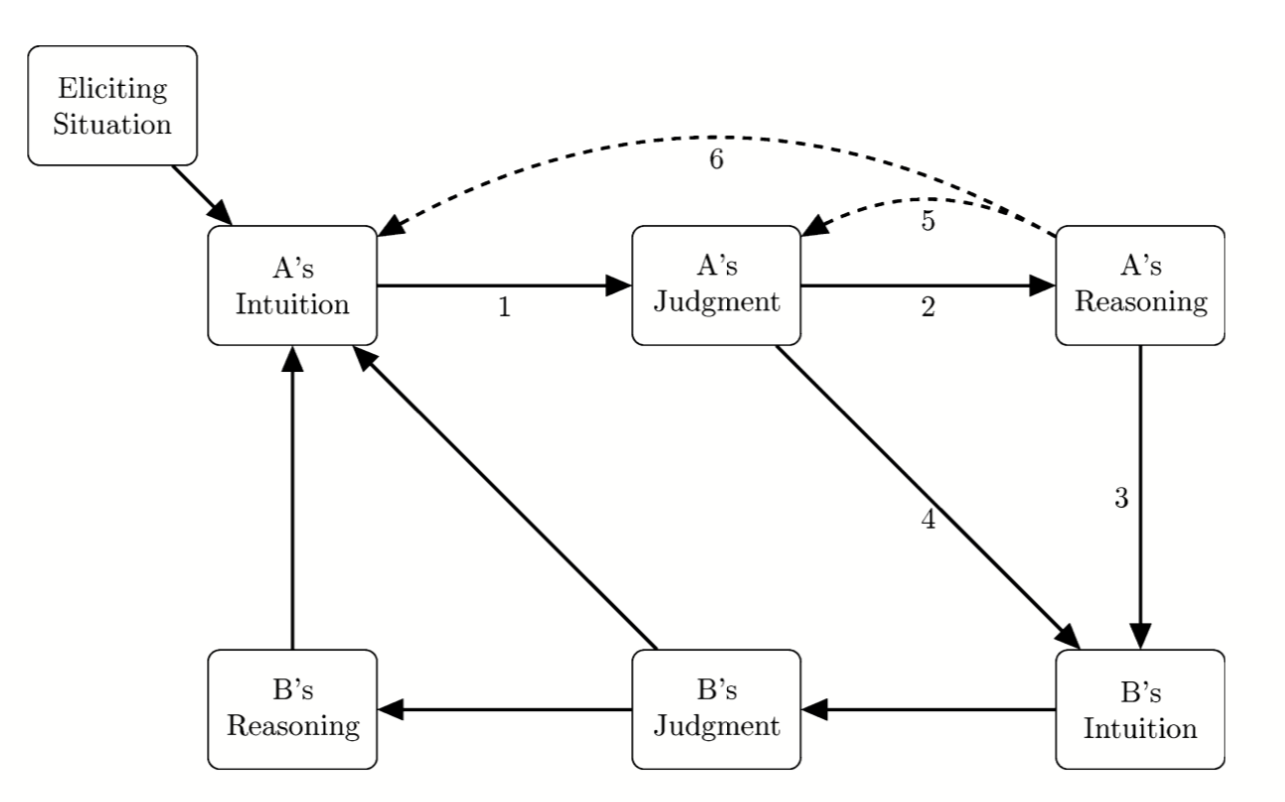 Figure: The Social Intuitionist Model of Moral Judgement. Arrows are interpreted causally. Dotted lines represent connections of low significance. Source: Haidt & Bjorklund (2008, p. figure 4.1)
Hint: The claim about reasoning being primarily strategic might conflict with findings on moral disengagement discussed in Moral Disengagement: Significance. This could be relevant for short essay question 3, On moral dumbfonding and moral disengagement.
4. Pluralism: Fourth, moral pluralism is true:
‘There are many psychological foundations of morality’ (Graham et al., 2019, p. 212).
This was the topic of Moral Pluralism: Beyond Harm. Initially, Haidt & Graham (2007) proposed five evolutionarily ancient, psychologically basic foundations: Harm/care, Fairness/reciprocity, Ingroup/loyalty, Authority/respect, and Purity/sanctity.
More recent work, including by original proponents, distinguishes six foundations, splitting Fairness into Equality and Proportionality[2]. These are often[3] grouped into:
- Individualizing foundations: Care (related to harm), Equality (related to fairness as equal treatment)
- Binding foundations: Proportionality (related to fairness as merit/contribution), Loyalty (related to ingroup), Authority (related to respect/social order), and Purity (related to sanctity/disgust).
Why are they called 'individualizing' and 'binding'?
‘The first two “individualizing” foundations—care and fairness—center around protection of individuals from harm and unfair treatment, whereas the “binding” foundations of loyalty, authority, and purity are focused on preservation of group cohesion, maintaining boundaries for self and group, and binding individuals into larger groups and institutions.’ (Atari et al., 2023, p. 1158)
It is not essential to the theory that these be the only foundations, nor that this specific list is final. The theory allows for flexibility and potential additions.[4] For instance, MFT initially seemed inadequate for capturing the moral concerns of Libertarians:
‘Libertarians have a unique moral-psychological profile, endorsing the principle of liberty as an end and devaluing many of the moral concerns typically endorsed by liberals or conservatives’ (Iyer, Koleva, Graham, Ditto, & Haidt, 2012, p. 21).
This led proponents to:
‘consider Liberty/oppression as a candidate for addition to our list of foundations’ (Graham et al., 2013, p. 87).
What Makes Something a Moral Foundation?
Where the initial description was ‘evolutionarily ancient, psychologically basic’, the standard criteria for identifying a moral foundation are more demanding:
‘(a) being common in third-party normative judgments (e.g., frequently appearing in gossip about rule violations), (b) automatic affective evaluations[5] (e.g., quick feelings of approval or disapproval), (c) cultural ubiquity though not necessarily universality (e.g., appearing widely in anthropological accounts, though perhaps elaborated differently across cultures), (d) evidence of innate preparedness (e.g., appearing early in development or having precursors in other primates), and (e) a robust preexisting evolutionary model (e.g., linking Purity to pathogen avoidance).’ (Atari et al., 2023, p. 1158)
Influence and Significance
Despite ongoing debate and recognized weaknesses (discussed below), MFT has been highly influential. Even critics acknowledge its impact:
‘It would be difficult to overestimate the influence of this theory on psychological science because it caused a dramatic broadening in conceptualization of morality beyond narrow Western notions that have focused on individualistic virtues associated with protecting one’s rights—especially prevention of harm (Gilligan, 1982) and unjust treatment (Kohlberg, 1969).
‘The expansion of moral psychology to more collectivistic domains has led to substantial research into the role of morality in the political environment. More specifically, there is significant support for the moral foundations hypothesis that predicts that conservatives tend to draw on virtues associated with binding communities more than liberals (Graham, Haidt, & Nosek, 2009; Graham et al., 2011; Koleva, Graham, Iyer, Ditto, & Haidt, 2012)’ (Davis, Dooley, Hook, Choe, & McElroy, 2017, p. 128).
And although it is usually categorised as psychology, Moral Foundations Theory can also be fruitfully considered as philosophy (and perhaps as anthropology).
Weaknesses and Objections to Moral Foundations Theory
Despite its influence, Moral Foundations Theory is perhaps the most difficult theory we encounter, partly due to significant challenges. Much of the evidence for key applications is at best quite weak (Davis et al., 2016; Doğruyol, Alper, & Yilmaz, 2019; Kivikangas, Fernández-Castilla, Järvelä, Ravaja, & Lönnqvist, 2021). Applications of MFT also face significant theoretical objections (we have already seen one objection in Moral Disengagement: Significance). These weaknesses have recently led to the development of new and improved ways to study moral foundations across different groups (Atari et al., 2023), acknowledging and attempting to overcome earlier objections. We must therefore treat claims based on earlier MFT work with caution, as these limitations are now widely recognized.
Hint: If you rely in an essay on discoveries based on Moral Foundations Theory, you must show awareness of relevant limits and objections. These will be covered later in the course.
Glossary
References
Endnotes
Graham et al. (2019) is probably the most accessible introduction, and this is the main source I follow in the lectures. Although a book chapter, it is available online. Haidt (2007) is useful if you are short of time. The theory first appears in Haidt & Graham (2007). ↩︎
The six foundations are called Care, Equality, Proportionality, Loyalty, Authority and Purity (Atari et al., 2023, p. table 2, 1161). These researchers cite Meindl, Iyer, & Graham (2019) as justifying the distinction between equality and proportionality. ↩︎
Note that the individualizing—binding distinction is also supposed to be culturally variable:
↩︎‘the individualizing-binding distinction made in Graham et al. (2011) may actually be culture dependent. Accordingly, one may not assume that two-dimensional higher order structure exists in all cultural contexts.’ (Atari et al., 2023, p. 1181)
For example, Moral Foundations Theory has had some difficulties with Qeirat, a type of honour focussed on family, friends and community that is closely related to mate retention and ‘protecting a loved or sacred thing or person against intrusion’ (Atari, Graham, & Dehghani, 2020, p. 369), suggesting it might be another candidate foundation, particularly relevant in certain cultures. ↩︎
Given the mixed evidence on the role of feelings and emotions in moral intuitions, (see Moral Intuitions and Emotions: Evaluating the Evidence), one might question whether anything meets all five of these criteria for being a foundation. It may be possible to substitute revised criteria which involve fewer bold empirical commitments but still capture the core idea that some aspects of ethical judgements are more foundational than others. ↩︎